Drought and Wildfires – Practical Advice for Businesses
Following the current ongoing drought and wildfire events in Suffolk, this month’s sustainability blog has been put together to signpost businesses to sites that can offer practical advice around how to mitigate future droughts and wildfires and what to do in the event that they are affected.
You can keep up to date with all emergency preparations in Suffolk here
Drought
All Businesses
Preparing for Drought: Practical Advice for Businesses
Building Water Resilience: How UK Businesses Can Respond to Drought Risk
Save water and reduce your carbon footprint – UK Business Climate Hub
Dry weather information and advice – NFUonline
Drought: Improving Resilience for Your Business
Drought and water availability – GOV.UK
How to save water | Waterwise
Use the template below to create a Water Efficiency Management Plan – This will help to track you water usage over a long period of time and identify areas of concern and help you more effectively manage and reduce water usage.
Water Efficiency Management Plan – Template
Farming and Land Management
Extreme weather guidance for farmers and land managers – GOV.UK
environment-and-climate-change.pdf
Staying safe during drought
Public health impact of drought: advice for the public – GOV.UK
WWS – Homepage | Waters Worth Saving UK
Wildfires
Wildfires – Prepare
Prepare and Protect Against Wildfires – NFCC
Wildfire Prevention Advice – NFCC
Protecting your Business from Wildfires | Lancashire Fire and Rescue Service
New campaign urges public to help prevent wildfires this summer – Suffolk County Council
Fire safety for farmers and rural businesses – Suffolk County Council
NFU calls for action to minimise wildfire risk as temperatures soar – NFUonline
Wildfires UK: Causes, risks and why they’re increasing
Wildfire insurance | Apex Insurance Brokers Wiki
Fire safety for small businesses operating from commercial premises – GOV.UK
Further Reading
Climate Change – Suffolk Resilience Forum
Suffolk-Climate-Emergency-Plan
The smallest changes make a difference. Take action at work.
How Climate Change Is Reshaping UK Business Insurance
Direct links to business pages are not an endorsement of the site’s products.
The Big Walk and Wheel – March 2026
The Big Walk and Wheel takes place this year between 16th and 27th March.
The purpose of this event is to encourage school children and staff to use active travel such as walking, cycling and scooting for their school commute.
The objective is to promote active travel as an enjoyable option to improve air quality around their schools, increase their physical fitness and gain an understanding of small changes they can make to benefit their local environment.
Why not take advantage of this event to talk about active and sustainable travel in the workplace.
Parents of school aged children may already be aware and possibly already participating with their children. This is an opportunity to build on that momentum.
The Big Walk and Wheel site has a host of suggestions and resources which could be useful to adopt to work setting, these include suggestions such as FRideday Bike Bus. This could be easily adapted to just FRideday, a day when everyone either walks, cycles or takes public transport to work.
If you use a cycle to work scheme, why not use this event to share how the scheme works. Promote the known benefits of cycling such as:
- increased metabolic rate, useful for maintaining a healthy weight
- increased muscle tone, particularly good for older people as a useful way to prevent future fall risks.
- Better overall fitness, with regular cyclists statistically being as fit as an average person 10 years younger.
Let’s not forget walking, you may have employees who already walk to work, why not ask them what they enjoy about their walk. Could they buddy up with other employees in their area who don’t usually walk for the week. Sharing the journey and boosting their mental and physical health at the same time.
It’s important to recognise participation, so why not create an achievable challenge for all to take part and celebrate success. Encourage employees to share their experience and work towards making it a regular or long term change.
If you don’t already have a sustainable transport policy why not use this event to look at creating one. The GHAW blog from November 2025 regarding sustainable transport is a useful starting point to think about why sustainable travel is important and what you should consider when writing a sustainable travel policy.
But most of all, have fun and get outside and active.
Ambassador Network Workspace
Ambassadors are invaluable, whether that is championing GH@W or spending time mentoring SME’s and sharing their knowledge and experience, setting goals and evaluating progress. The objective for the Ambassador network is for SME’s to create a self-supporting network for the long-term economic improvement of those SME’s and the Suffolk region.
To support the growth of this network we have created the Ambassador Workspace, this uses a google platform and includes: chat and video call functions which SME’s can use for free to communicate with each other, either 1to1 for peer mentoring or by creating topic specific forums, FAQ’s or just to chat with other businesses to network and support each other. We also have the Ambassador Site available which has information about being an ambassador, peer mentor and a training page with a growing range of free online training available. The Ambassador site is also great for sharing success stories, case studies and just generally shouting about how great our SME’s are.
If you would like to join the Ambassador Network Get In Touch
International Volunteer Day – December 2025
International Volunteer Day falls on 5th December 2025 and this year, as well as encouraging volunteering for the day, International Volunteer Day will be used to launch the UN International Volunteer year for 2026. The theme for the event will be solidarity through volunteering and will encourage people to participate in community, national and global volunteering initiatives.
Volunteering has a long and varied tradition in the United Kingdom, with records dating back to the 12th century. Typically UK volunteers tend to engage in supporting individuals, communities, charities and even the NHS. Volunteers also play vital roles in supporting conservation and environmental projects as well as education and the arts. Thus ensuring that important social benefits continue to be available. In England alone the total economic benefit from volunteering is approximately £25bn. With the estimated cost of wellbeing benefits per volunteer being around £673 per volunteer or £8.6bn in total(1).
Volunteering has been proven to improve mental and physical wellbeing with the Time Well Spent: A national survey on the volunteer experience recording:
Over three-quarters (77%) of volunteers agreed that volunteering had improved their mental health and wellbeing; this compares with just over half (53%) who agreed their physical health had improved (note, these were separate statements, so respondents could agree with both).(2)
As well the benefits to both mental and physical health, the Royal Volunteer Service states that following feedback the benefits to the volunteer have a huge impact on their lives and include:
- Building new skills
- Getting valuable work experience
- Making new friends
- Improving their physical & mental health and wellbeing
- Giving something back
- Improving their confidence
- Connecting with others in their community
- Improving how things work for the better (3)
So, how can your workplace benefit from volunteering?
Over the past two decades it has become increasingly popular for organisations to offer volunteering opportunities to their employees. This can take a couple of different forms, such as:
Offering a volunteer time allowance
A volunteer time allowance works on the principle that an employee has 1 or 2 days a year which they can use to volunteer for an organisation, whilst still receiving pay. The benefit of this is that you may have staff who already volunteer or who want to volunteer for a particular project. Offering volunteer time as an employee benefit, allows them to get on with it without worrying about losing a days wages.
Workplace Group Volunteering
Alternatively, you may consider workplace group volunteering. Many organisations and charities that rely on volunteering now offer group volunteering for workplaces. This allows for small work groups from businesses to work together on a specific project and is organised directly via the business. Forming part of an employee benefit package, it is a good opportunity for team building away from the workplace. Staff are paid as usual and the company benefits from improved staff welfare, stronger teams and, can record it against their corporate responsibility and social value index.
Consider which approach would be most appropriate for your business and make an informed choice about what you want your business to gain from volunteering. Think about how you could incorporate volunteering into your own social value index.
Volunteering and Sustainability
You might be wondering how sustainability and volunteering are linked excluding the obvious exceptions of volunteering for environmental or sustainability charities and organisations.
Committing to long term volunteering whether that is as a regular weekly volunteer or a regular corporate project volunteer creates ongoing positive, lasting and measurable impact. Strengthening communities and social bonds, and improving the lived environment for many. Working together in a voluntary capacity increases the desire to make improvements, creating a sort of beneficial feedback loop as more benefit from these acts of kindness. Repeated volunteering allows growth in skills and confidence which can also then be passed on to new volunteers or shared amongst friends and family.
Why not take advantage of some of the volunteering opportunities in Suffolk. Canvas staff opinion, you may find that some of your staff are already volunteering, why not ask them to share their experiences?
Above all, think about what skills and time your organisation could offer, maybe this is just offering to man a stall for a couple of hours. All of these volunteer actions added together help to make a big change!
Volunteer Organisations in Suffolk
Home – Volunteer Suffolk
Volunteer – Red Gables
Welcome to RSPCA Suffolk Central
Home | Suffolk Wildlife Trust
Stowmarket & Area Foodbank – LivingIt
References
1https://www.civilsociety.co.uk/news/volunteering-in-england-valued-at-25bn-a-year-by-government-research.html
2Volunteer impacts – Time Well Spent: A national survey on the volunteer experience | News index | NCVO
3 Benefits of Volunteering | Royal Voluntary Service
Sustainable Travel – November 2025
November 24th is World Sustainable Travel Day and sustainable travel is an excellent opportunity for employers and employees to improve their understanding of sustainability and how easy it is to implement a sustainable transport policy. A sustainable transport policy can benefit the business by reducing its carbon footprint and can also benefit employees by improving their health and their local environment.
So, what is sustainable travel?
Sustainable Travel refers to the idea that it is possible and necessary to travel well by reducing or removing reliance on vehicles that burn fossil fuels and create greenhouse gases such as CO2. Since its inception as a philosophy in the 1970’s sustainable travel has grown to incorporate many areas including:
- Sustainable Transport Networks
- Sustainable Freight
- Sustainable Tourism
- Regeneration Tourism
- Responsible Travel
Although your business may cover more of these, here we will focus on sustainable transport, its benefits, impacts, and how with a few changes you can create a sustainable transport policy that can be adopted and used towards completion of the Good Health @Work Standard 6: Social Responsibility and Environmental Sustainability.
Follow this link if you would like to learn more about the Good Health at Work Standards.
What is sustainable transport?
Sustainable transport as defined by the UN ‘refers to mobility systems that seek to minimise greenhouse gas emissions and environments, while ensuring safety and affordability, improving energy and resource efficiency and providing equitable mobility for all.’ (1)
Importantly, sustainable transport does not refer to one single solution, and neither should you. When considering sustainable transport for your business you may immediately think of how you and your employees get to and from work. However, transport covers a vast array, including for instance:
- Importing/Exporting
- Deliveries
- Team or company meetings
- Field Sales
- Field Maintenance
- On site work such as plumbing etc
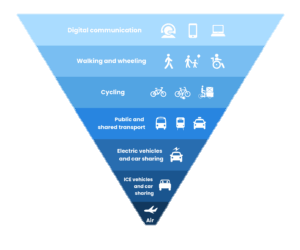
The sustainable travel hierarchy below is quick reference to help you understand where each mode of transport sits in terms of sustainability, with digital communication being the most sustainable and air transport being the least.
Why is sustainable transport important?
Currently 13.7% of all global greenhouse gas emissions are generated by the transport sector. These greenhouse gases contribute to global heating and accelerated man-made climate change, as well as causing air pollution which is estimated to contribute to 6.7million premature deaths a year.
In the UK alone 66% of commuters travel by car (3), this is largely a result of gaps in public transport, particularly noticeable in rural areas and for shift workers who keep unsociable hours. As well as the pollution caused by the cars themselves, they can also add pressure to employers to provide parking and employees (where required to pay for it), which adds an additional financial stress.
All of this can affect staff recruitment and retention. The COVID pandemic and the increase in remote working there has been an increase in employees choosing to leave jobs because of a bad or unnecessary commute as they have become increasingly able to find remote work which in itself improves workplace sustainability.
Implementing a sustainable transport policy can help your business play its part in reducing green house gas production whilst also providing other benefits such as improved physical and mental health and creating demand for better public infrastructure.
What should you include in your sustainable transport policy?
First things first, before creating your policy, take time to survey your employees and supply chain to understand their current choices. You may find some of your workforce are already travelling sustainably and you will get a better sense of why those choices are made how they can influence others. Indeed, you may also find that the delivery vehicles that bring your parcels are electric. Surveying and understanding your current situation allows you to write a policy that can have some worth rather than being a tick box exercise.
When writing your policy consider all the various types of transport that are used by your business, staff, suppliers etc. Break this down by category and consider what power you have to improve the sustainable transport for those categories.
For instance, you may be able to offer employees a bike to work scheme or provide good cycle storage, or create a carpool system where overall journeys are reduced due to car sharing. Alternatively, if you are a business with vehicles, you may wish to commit to renewing with electric vehicles rather than petrol or diesel. It is also important consider your supply chain, do you have any influence to select businesses who have themselves committed to a sustainable transport policy and introduced electric delivery or fleet vehicles. Consciously consider the choices that you have available to you and bring the idea of sustainability into your long term strategy.
Bring people along so that they are excited by the possibilities for themselves as well as the business, for example use employees that are keen to get involved by creating sustainability champions who can raise awareness of the policy, what’s available and what the benefits are.
What should a Sustainable Transport Policy look like?
A sustainable transport policy should take the format of other standard employee policies. This keeps it familiar whilst giving a good breakdown of roles, responsibilities and expectations.
As with all policies it is important to lay out:
Purpose: What you want it to achieve
Scope: How far you want your policy to go, who is included and to what extent
Promotion: What are you going to do to promote awareness of the policy and your expectations of the policy
Support: What support are you going to put in place to ensure that the policy is achievable
Long term planning: How will this policy influence your long-term strategy
Manager Responsibilities: What are your expectations for the managers to ensure the policy can be implemented effectively and fairly.
Employee Responsibilities: What are your expectations of your employees when they engage with this policy.
Confidentiality: Does this policy require a confidentiality clause and if so how will you apply it and to what parties.
Review and Continuous Improvement
Will this policy be reviewed annually, or sooner, if necessary, to ensure it reflects current best practices. How will you review this policy? Will it rely on feedback from employees and stakeholders? How will you implement this?
What Next?
Once you have created your policy, promote it widely across your organisation. Encourage your workforce to share their experiences of swapping to sustainable travel and use internal comms to celebrate these achievements.
To understand the material difference the policy has made, implement a recurring sustainable travel survey. Measuring your progress will not only help you understand the improvements you have already made but will shed light on any areas that could be improved.
Want to know more.
If you are interested in learning more about sustainable travel here are some resources you may find useful.
Sustainable travel – BBC Bitesize
Workplaces – Walk Wheel Cycle Trust
An introduction to the sustainable travel hierarchy – Energy Saving Trust
Action Net Zero
References:
1What is sustainable transport and what role does it pay in tackling climate change? | UNDP Climate Promise
2An introduction to the sustainable travel hierarchy – Energy Saving Trust
3The employer’s guide to sustainable commuting
